Autocatalytic

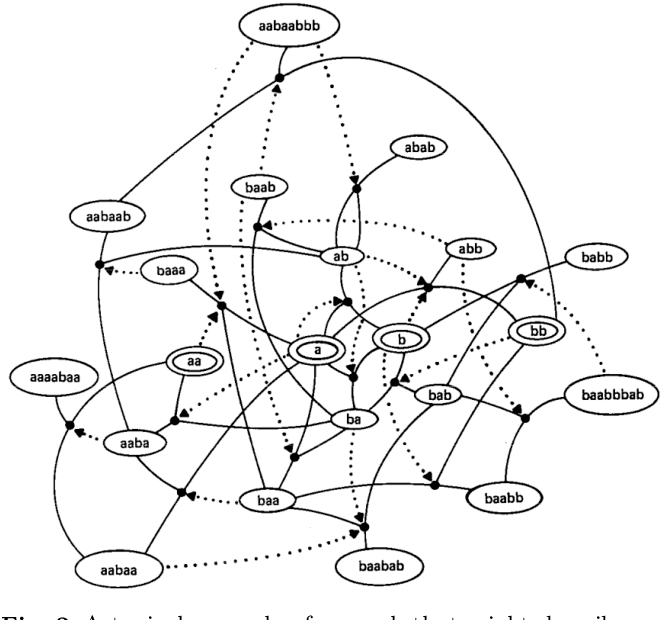
All this business about OpenClaw reminds me of a concept I learned in grad school: autcatalytic sets (aka hypercycles).
An autocatalytic reaction or process is one where the product itself acts as a catalyst for the reaction that produces it — meaning the reaction accelerates as it proceeds, because more product means more catalyst.
The basic case is a reaction A → B, where B catalyzes the conversion of A → B. So the more B you have, the faster B is made. This type of reaction is very rare. But same logic can apply to more complex chain reactions (A → B → C → D ...), in complex networks, like the cover pic for this post. This can get very mathy.
Autocatalysis is a key mechanism behind positive feedback, self-organization, and emergent complexity. It's one way simple chemistry could have bootstrapped into self-replicating life — an RNA molecule that catalyzes its own replication is an autocatalytic system.
It also underlies ideas about tipping points: once an autocatalytic process gets going past a threshold, it can become very hard to stop, until its are exhausted. Locally, autocatalytic reactions often follow a sigmoidal growth curve. Going back to the A → B example: growth is slow at first (little B present), then rapid acceleration, then leveling off as A is depleted.
Some autocatalytic sets are turing complete, which means that in principle, they could be used to play Doom.
The attack surfaces of autocatalytic set have interesting (and not fully understood) properties. In chemical systems, "attacks" take the form of poisons or viruses that can block or hijack feedback loops. The attack surface expands with the system. However, you can also think about these attacks as part of the system, guiding resources to alternative metabolic pathways.
Autocatalysis turns out to be a useful way to think about many kinds of complex systems.
- Chemistry — certain reactions like the oxidation of oxalic acid by permanganate, where the Mn²⁺ product catalyzes the reaction
- Biology — proteases that activate themselves or each other (e.g., trypsinogen → trypsin, which then activates more trypsinogen); also proposed in the origin of life (RNA world hypothesis)
- Ecology / epidemics — disease spread, where more infected individuals produce more transmission events. Niches
- Economics — network effects, where adoption of a product makes it more valuable, driving more adoption.
- Social dynamics — viral information spread, cascade effects
Thinking about social dynamics / economics: I have a strong hunch that many of the dynamics behind startups (long-tail outcomes, J-curves, risk at various) could be described accurately by autocatalytic sets.
A couple other refs:
William Gibson won my undying adoration when he used the phrase in The Difference Engine.
In this City’s center, a thing grows, an auto-catalytic tree, in almostlife, feeding through the roots of thought on the rich decay of its own shed images, and ramifying, through myriad lightning-branches, up, up, toward the hidden light of vision,
If you want a deeper dive on autocatalytic sets and the origin of life, Kauffman's At Home in the Universe is worth a read. It's a pop science book, a bit on the dense/thoughtful side. Also has a touch of mystery/awe that I remember appreciating in grad school.
What does this have to do with OpenClaw?
- It's a self-building ecosystem. The OpenClaw ecosystem is building itself. Users report it autonomously creating and deploying new skills. Other open source projects are also have a "self-building" network of organic contributors, but none has ever been AI-powered in this way before. This looks a whole lot like an autocatalytic loop: where outputs feed back to accelerate the system's own growth
- S/J-curve growth: OpenClaw went viral in January, with open-source network effects and the Moltbook project acting as a seed catalyst.
- Attack vectors. OMG, so many attack vectors
- log poisoning lets attackers embed instructions in self-debugging routines;
- infostealers now targeting OpenClaw config files
- Meta and others have banned OpenClaw from corporate networks — the classic response when an autocatalytic process outpaces safety mechanisms