Subjective measures

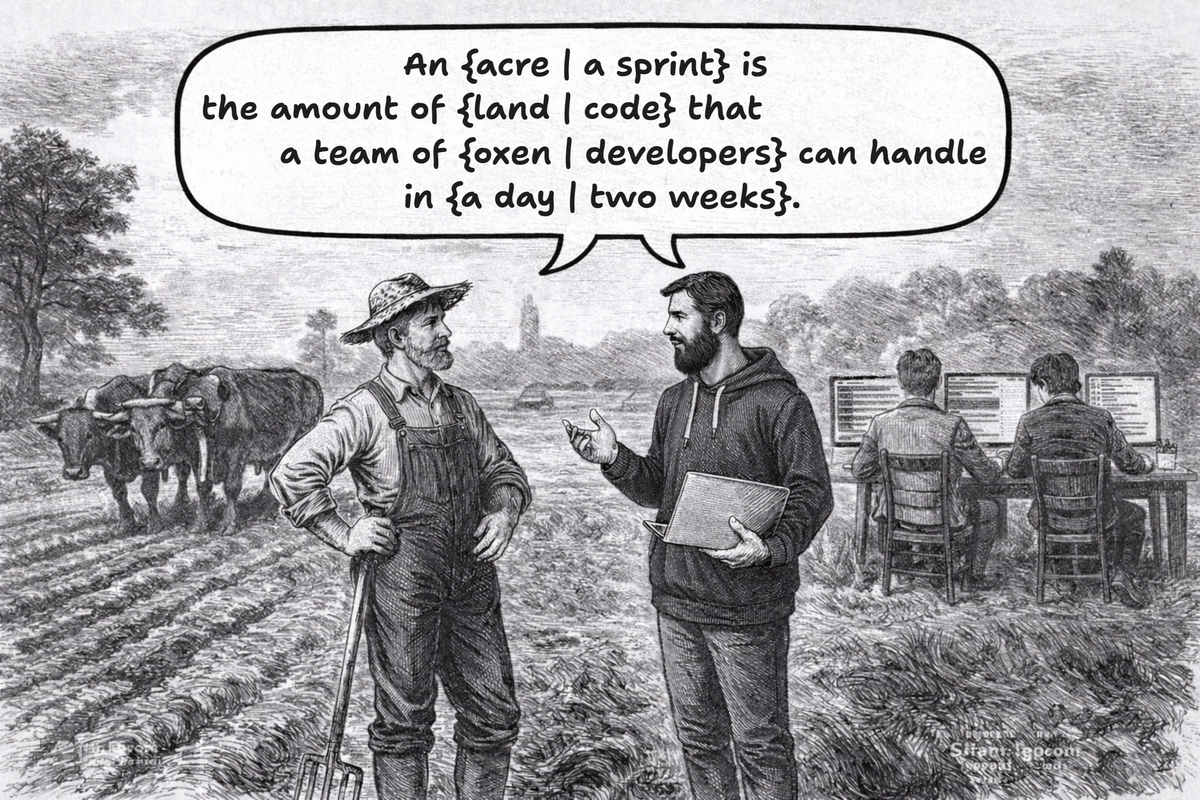
In days of yore, an "acre" was the amount of land a yoke of oxen could plow in a day. I love that today, a "sprint" is the amount of code that a team of engineers can complete in (about) two weeks.
Totally subjective and context-dependent.
I believe that this about to change. One of the under-appreciated effects of AI is that it's going to make many aspects of informative work, office culture, etc much more directly observable, which is going to make them objects of scientific study, which will change them from subjective to objective.
Associated links, pics and ideas
Medieval measures
A bunch of measures that started off subjective and were later standardized:
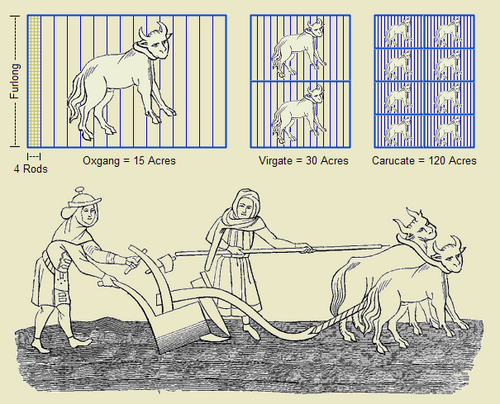
- An acre was originally the amount of land a yoke of oxen could plow in a day.
- A cubit was the length of the forearm from elbow to the tip of the middle finger, originating in Egypt around 3000 BC.
- A fathom was the span of a man's outstretched arms, fingertip to fingertip.
- A foot was originally the length of a human foot, supposedly standardized by King Henry I.
- A furlong was originally the distance a team of oxen could plow without needing rest — a "furrow's length" of 220 yards.
- A hand was the breadth of a human palm, standardized at 4 inches by Henry VIII and still used for measuring horses.
- A hide was the amount of land needed to support one household, which varied by region and soil quality.
- An inch was originally the width of a man's thumb — in many languages, the word for "inch" is still the word for "thumb."
- A league was roughly the distance a person could walk in one hour, derived from an ancient Celtic unit.
- An oxgang was the amount of land a single ox could plow in one annual season — one eighth of a carucate.
- A stone was originally any good-sized rock chosen as a local standard, with its value fluctuating by commodity and region.
- A yard was reportedly the distance from King Henry I's nose to his outstretched thumb.
See also: barrel, bushel, cable length, hogshead, stone's throw, etc.
Obligatory

Developer measurement jargon
- A sprint was originally just how much work a team could do in one burst before needing to rest — typically one to four weeks, now usually standardized at two, much like a furlong standardized at 1/8 mile.
- A user story was a short narrative written from the perspective of an end user — called a "story" because it was meant to spark a conversation, not define a specification. Originated in Extreme Programming (XP).
- An epic is simply a story too big to finish in one sprint — the term borrowed from literature, where an epic is just a really long story. Mike Cohn introduced the concept in 2004.
- Story points were invented by Ron Jeffries as part of Extreme Programming — originally a deliberate abstraction to hide time estimates from managers by replacing "ideal days" with unitless relative numbers. Jeffries has since said "I may have invented story points, and if I did, I'm sorry now."
- An issue is a catch-all term in tracking systems for any item that needs resolution — bugs, features, tasks, and stories are all subcategories. The related tickets are called so because of their origin as small cards on a wall-mounted planning board.
- A bug was used by Thomas Edison in the 1870s to describe mechanical malfunctions, then famously cemented in computing lore when a literal moth was found in the Harvard Mark II in 1947 and taped into the logbook as the "first actual case of bug being found."
- Velocity is how many story points a team completes per sprint — essentially "how far the oxen can plow in a day" restated for software, and equally variable depending on conditions.
- A spike is a time-boxed period of research to reduce uncertainty — named for driving a spike into the ground to test what's underneath, though I haven't found a definitive origin source for the metaphor.
Wondermark
Searching for "lithograph memes," I discovered that Wondermark is back! David Malki took a hiatus for a few years, and started reposting. I may need to make this my profile pic: