Jev: The best hot takes, one week in

Now that the first wave of hype about Jev has washed over us, we can be a little more thoughtful.
Here are my favorite hot takes on Jev, plus a bunch of second-order effects that I don't think most people are tracking yet.
I love the way that Typesafe is putting a new AI primitive on the map.
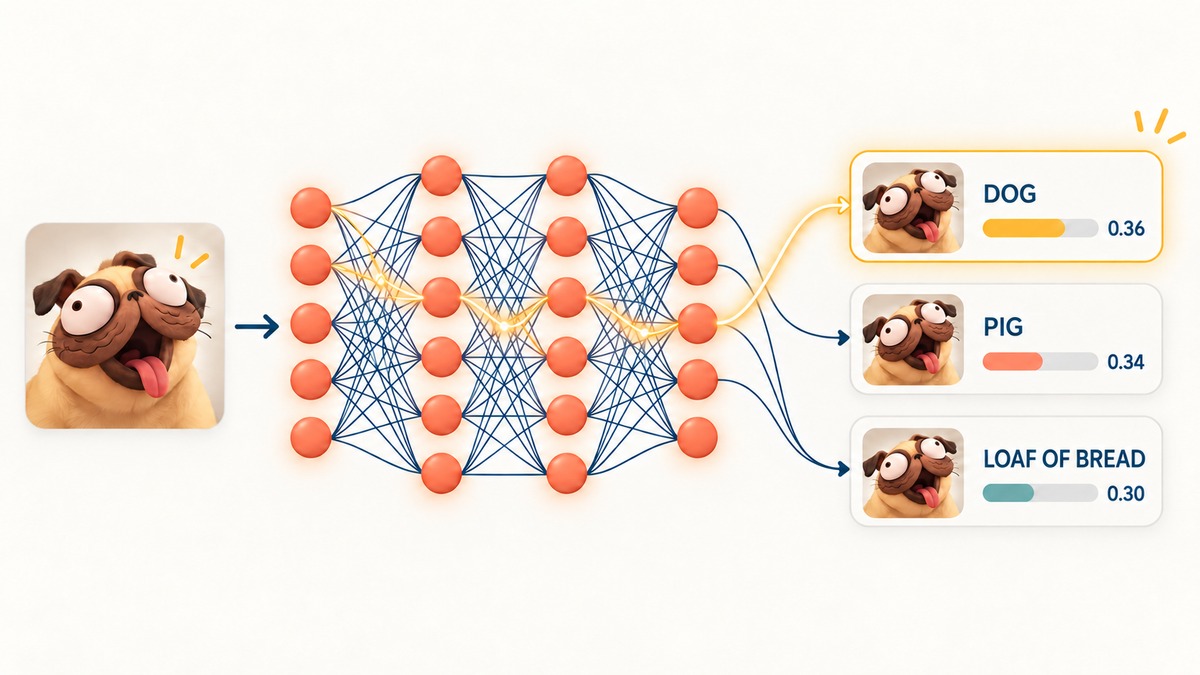
- Ever since ChatGPT launched, lots of people have assumed that AI = chat, or maybe (for those who encountered midjourney or "in the style of studio Ghibli" first) that AI = generative.
- I love the way Diogo mocks the AI/ML tourists who don't understand that the possibilities for AI are much broader and weirder.
- I don't love how he contorts the meaning of words like "hallucination." But hey, he's cut through the noise, and real conversations are happening. Kudos for that.
- Side note: "System 1 models" is a pretentious and obnoxious name for "classifier." Let's starve it out. (I suppose I can live with "decision model".)
- Some of the Jev haters have pointed out that Jev isn't that different from previous techniques, like confidence-aware routing, NLI models, GLiCLass, and "calibrated RL."
- That's not the point. The vast majority of software developers—including many of the ones who think of themselves as AI-pilled/AI native—weren't aware of these options before. Now they are.
Making good use of Jev-like classifiers is going to reward insightful task decomposition.
- Over the last year, companies got very excited about tokenmaxxing, then realized that cost control matters, too.
- On-the-ball teams were already starting to decompose knowledge work into tasks that require a frontier LLM and tasks that can be done with less intelligent LLMs.
- As devs become aware of new AI primitives (like classification), they're going to be looking for new ways to decompose work to take advantage of them.
- For example: parallelization, which then unlocks things like map-reduce.
- Workflows (as opposed to agent loops) have mostly fallen out of favor in 2026, but I would guess that we're probably going to see more teams building workflows again soon. Workflows are a natural complement to classification. Yes, they can be brittle and hard to configure, but (used judiciously, and composed cleverly with loops) they're a good answer to the cost + reliability concerns that often limit agent usage.
- Ontology-based wokflows are also going to benefit. Classifiers are great when you already have a trusted taxonomy.
Adoption of non-chat AI primitives is going to disrupt the economics of intelligence even faster.
- While repenting of tokenmaxxing, the market collectively learned how to read pareto maps showing the cost/intelligence frontier.
- Classification-as-a-primitive opens up totally new options for building with intelligence: for some tasks, they are far above the LLM frontier: higher quality, but also much cheaper and faster.
- It's also going to make it much cheaper and easier to evaluate quality, both within classification tasks themselves, and within LLM-as-judge-type workflows. I bet this creates a virtuous cycle with task decomposition.
- TypeSafe's founders and investors seem very aware of these dynamics.
- Certain applications will get much cheaper now, which will open up new AI form factors and business models.
I'm curious what TypeSafe's long-term business model is.
- The initial launch looks like an infrastructure play, but that seems hard to defend.
- The margins are probably razor thin, credible open-source alternatives are already available, and I would guess that Jev-style models are even more vulnerable to distillation than LLMs.
Jev brings back a performance metric that many people had stopped thinking about: latency.
- Historically, latency has been extremely important for good UI. Humans are very sensitive to delays above 100ms.
- The current wave of agentic tools have completely neglected this. I blame reasoning—it got frontier models to a level where they can code effectively, but at the cost of agents that—against the normal principles of good interaction design—constantly mutter to themselves, and fill up many screens with text that mostly isn't worth reading.
- As a result, we've been stuck in an unhappy middle where agents often need close supervision, but they don't act fast enough to fully hold our attention.
- Working with this generation of agents creates a kind of cognitive burden that falls somewhere between draining and soul-killing.
- I'm very excited about decomposing intelligence down to the point where it enables new kinds of interfaces, with a better division of labor between focused, synchronous actions, and asynchronous background tasks.
- On that note, having Jev play Doom is a clever existence proof that AI doesn't always need to be slow and chatty.
Last thought: there are plenty of other AI primitives waiting to be discovered / invented / popularized.
- AI isn't chat.
- I suppose it shouldn't be surprising that an anthropomorphic form factor (chat) was the first to become massively popular.
- But there's nothing intrinsically chat-based about intelligence.
- The future of AI is going to be a lot weirder and more powerful than we imagine.