Vouching
Unlike other languages, English has no grammatical way to mark where your information came from. So we've built a colorful and extensive vocabulary for the people who exploit that loophole.

Vouch (verb): to assert or confirm as a result of one's own experience; to stake your own credibility on someone else's claim. From Old French vochier / Latin vocare — "to call, to summon." Originally a legal term: calling a witness to stand as guarantor.
Evidential markers in Japanese
In Japanese, how you know something is baked into the grammar itself. You conjugate verbs differently depending on whether you've observed something directly, been told something, or drawn your own conclusion.
- 雨が降りそうです — ame ga furi-sō desu — "it looks like it's going to rain." furu means "to rain," and when it's conjugated as furi-sō, that marks direct-evidence inference. This is what you'd say if you're outside, feeling the weather and looking at the clouds.
- 雨が降るそうです — ame ga furu sō desu — "I hear it's going to rain." The slightly different conjugation (furu sō) now marks hearsay. This is what you'd say if you're in an office with no windows, passing along information from someone who just came in from outside.
- 雨が降るらしいです — ame ga furu rashii desu — "apparently, it's going to rain." A different suffix (furu rashii), marking a softer, more indirect form of hearsay. This is what you say when you've heard it around, but not from a specific source you'd vouch for. Might be appropriate if you're inside, no windows, and Siri told you that it's going to rain.
- 雨が降るようです — ame ga furu yō desu — "it seems like it's going to rain." Yet another suffix (furu yō), marking circumstantial inference. This would work if you're inside and you just heard a roll of thunder.
Linguists call this evidentiality, the encoding of how you know what you think you know. Japanese has grammaticalized evidentiality, meaning it's built into morphology, not just optional adverbs. Other languages with rich evidential systems include Turkish, Quechua, and many Tibetan languages. Some have as many as 4–6 distinct evidential categories.
Because evidentiality is built directly into the grammar, it's often difficult assert something in Japanese without indicating where you're getting your information from. The language has a bias towards citing your sources.
English has no such requirement. We have words that can mark provenance ("apparently," "allegedly," "I'm told") but they're always optional, easily omitted, and often are.
A Vocabulary of Bad Faith
Maybe that's why English has developed such a rich vocabulary for people who speak in bad faith—for the precise mechanisms of hidden motives and manufactured opinions.[1]
For example, Shakespeare alone gives us a small thesaurus.
- In Twelfth Night, Maria plots against Malvolio: "If I do not gull him into a nayword, and make him a common recreation, do not think I have wit enough to lie straight in my bed."
- In The Comedy of Errors, Antipholus warns himself about the city he's just arrived in: "They say this town is full of cozenage... Disguisèd cheaters, prating mountebanks, / And many suchlike liberties of sin."
- In Othello, Iago — bad faith in human form — sneers at servants who only pretend loyalty: "Whip me such honest knaves!"
- In A Midsummer Night's Dream, Hermia accuses Demetrius of lying: "An adder did it, for with doubler tongue / Than thine, thou serpent, never adder stung."
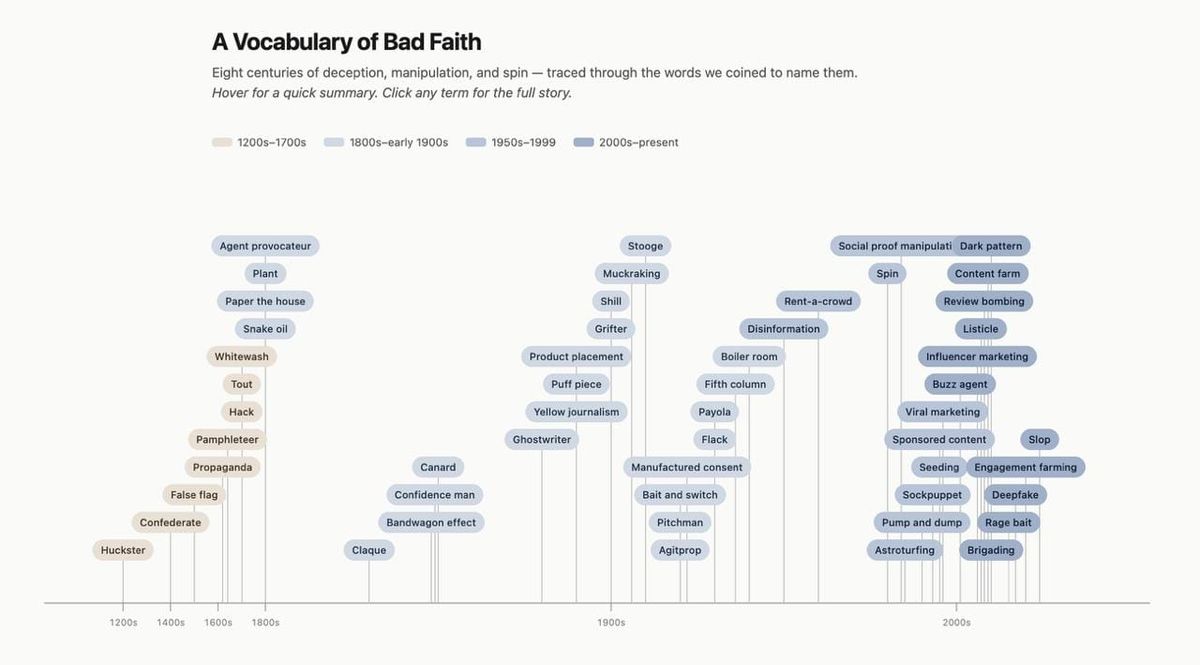
Just for fun, I asked AI to help me brainstorm the full inventory: as many English nouns as we could think of for a person, practice, or piece of content that exists to deceive. Then I had it dig into etymology and first attested use for each one.[2]
The result is this interactive timeline. Each term sits on the year it entered English; hover for the etymology, the era it peaked, and a one-line note on what it actually means. Color-coding groups them by category — individual deceivers, manufactured audiences, media manipulation, digital-era machinery. Scroll horizontally to watch the vocabulary thicken as we get closer to the present.
At their core, all of these words are about vouching—the act of staking your credibility on a claim. A shill appears to vouch for a product while hiding that they're paid. A sockpuppet appears to be an independent voice while being controlled by an interested party. Astroturfing appears to be grassroots enthusiasm while being manufactured by an organization. The entire vocabulary cluster is really about corrupted vouching—the simulation of independent judgment where none exists.
Trends over time
The vocabulary is a kind of fossil record of what each era figured out it was vulnerable to. Squinting a little, I see three main types of corrupted vouching.
The oldest of these words talk mainly about one-on-one interactions. A mountebank sold fake cures from a platform in the public square. A claque was the organized group of paid applauders at a Paris theater, with specialized roles for laughers, weepers, and encore-callers. A shill was the fake bidder at a carnival auction. These were individuals deceiving individuals — face to face, human scale.
Then came the megaphones, and the age of manufactured consent. Yellow journalism, propaganda, payola, puff pieces, spin — one person, or one office, working a whole audience at once. The deceiver was still recognizably human, but the audience had become a crowd. Print, radio, and television turned bad faith into a broadcast.
The newest words name something different again. Astroturfing, sockpuppets, deepfakes, engagement farming, slop — these aren't individuals at all. They're systems competing to shape understanding at industrial scale. Audiences in parasocial relationships with manufactured personas; models generating slop for algorithms to rank; bots talking to bots. Social flows of information are actively influenced in many ways by many parties, and we're starting to have jargon to describe how.